Neon Abyss 2 Early Access to 1.0 Guide: Release, Features & Systems
Explore Neon Abyss 2's journey from Early Access to 1.0. Discover 4-player co-op, weapon leveling, Hatchmon evolutions, and meta-progression strategies.
Published: Neon Abyss 2 Wiki Editorial Team
Table of Contents
Neon Abyss 2 Early Access: Launch History and the 1.0 Transition
Developed by Veewo Games and co-published with Kepler Ghost, Neon Abyss 2 made its initial debut in Steam Early Access on July 17, 2025. Over the course of its development cycle, the team expanded on the rogue 'n' gun formula of the 2020 original, incorporating player feedback to refine combat pacing, weapon scaling, and technical stability. The title reached its official version 1.0 milestone on October 7, 2026, launching with multi-platform availability and verified compatibility for handheld devices.
The game is currently available on the official Neon Abyss 2 Steam Store Page, where English player reviews stand at a "Very Positive" 87% rating across more than 400 reviews. Across all supported languages, total lifetime reviews sit in the "Mixed" tier (with over 2,000 total submissions), largely driven by community discussions around Early Access balance, screen visibility, and localized text strings. For players tracking the game's roadmap, the transition to 1.0 marks the completion of the baseline agent roster, official online networking, and the expanded cybermyth dungeon floors.
Early Access Launch: July 17, 2025
Version 1.0 Launch:   October 7, 2026
Core Focus:           4-Player Co-op, Melee Combat, Gun Dimension, Faith Mechanics
Core Gameplay Loop: Floors, Agents, and Combat Mechanics
A standard excursion in Neon Abyss 2 takes between 30 and 45 minutes to complete, depending on room routing and combat efficiency. The dungeon layout consists of five primary floors populated by enemy encounters, challenge chambers, and hidden passages. Defeating the boss at the end of each floor unlocks subsequent sectors, culminating in a climactic encounter against cybermyth deities. Overcoming the final boss unlocks elevated difficulty tiers that alter enemy density and reward scaling.
Players select from a roster of specialized agents, each possessing distinctive base attributes and starting artifacts that reshape tactical approaches. For example, Saya returns from the original title with the dedicated ability to swap seamlessly between firearms and a katana, accommodating aggressive close-quarters combat alongside traditional ranged gunplay.
Tip
No Contact Damage: Unlike many classic action platformers, running into standard enemy sprites in Neon Abyss 2 does not inflict physical collision damage. Your primary threat is projectile bullet hell fire, allowing you to reposition aggressively around melee targets without fear of incidental body checks.
The control scheme has been tailored for modern twin-stick gameplay, with developers and community testers strongly recommending an Xbox or PlayStation gamepad:
Left Trigger (LT): Dedicated jump button, allowing simultaneous vertical movement and precision crosshair tracking.
Right Trigger (RT): Primary attack trigger for sustained automatic firing or melee swings.
Right Stick: 360-degree manual aiming, paired with an optional, toggleable auto-aim feature that automatically snaps weapon paths toward nearby threats.
Weapon Crafting, Item Synergies, and the Gun Dimension
Weapons represent the focal point of character scaling in Neon Abyss 2. While the original game emphasized firearms, the sequel broadens the arsenal to include heavy bats, sabers, biological plant armaments, and dragon-like familiars. Rather than forcing players to abandon starting gear when higher-tier guns drop, the game implements a dismantling and tier-progression system.
Level 1–4 Weapon Scaling
Found weapons can be broken down on the fly for weapon experience points. Feeding redundant gear into your active weapon levels it from Level 1 up to Level 4, increasing base damage output and triggering unique weapon traits.
The Gun Dimension
Whenever an equipped weapon achieves an experience threshold and ranks up, the game transports the agent into the "Gun Dimension." This specialized pocket space offers a curated choice between powerful passive artifacts before returning you to the run.
Unlimited Item Stacking
Artifacts dropped throughout the Abyss function as cumulative passives. There is no inventory ceiling for passive items, allowing health expansions, triple jumps, defensive wisp familiars, and projectile multipliers to stack infinitely.
This weapon ecosystem encourages players to commit to an archetype early while continually harvesting unwanted floor loot to push a single weapon's damage ceiling into the late-game floors.
Minion Builds and Resource Management: Hatchmons, Curios, and Faith
Beyond standard guns, runs are heavily shaped by two distinct companion and resource subsystems: the companion-based Hatchmon cycle and the dual-currency economy of Crystals and Faith.
Hatchmon Evolution Dynamics
Hatchmons return as collectible eggs that trail behind your agent across rooms. After clearing a prerequisite number of battle encounters, eggs hatch into combat familiars that fire automated projectiles, absorb incoming hazards, or generate utility drops.
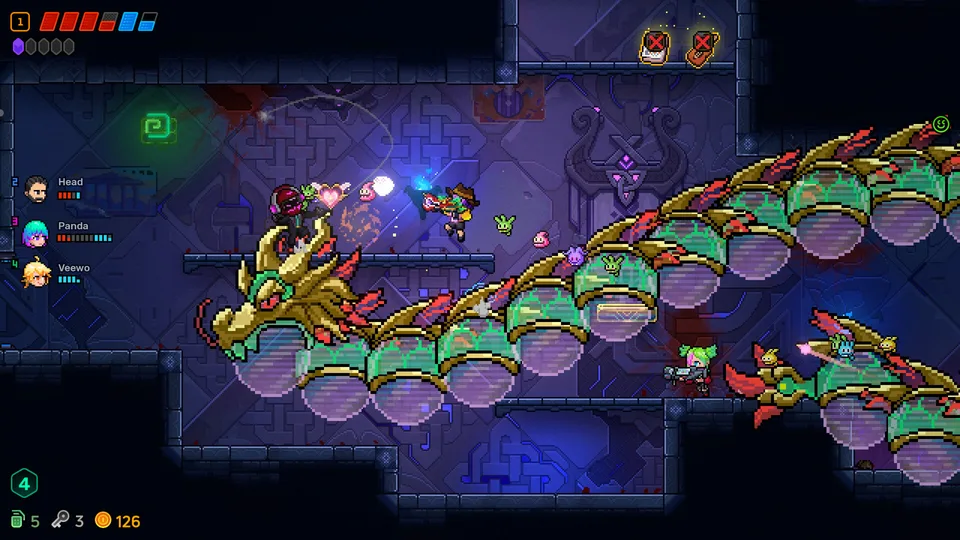
An in-game encyclopedia tracks specific Hatchmon fusion recipes. If an agent gathers a designated combination of active Hatchmons, the minions merge into advanced, mutated combat forms. However, player experience reports emphasize that acquiring specific eggs remains largely randomized. Because picking up eggs costs nothing, your squad of minions naturally expands over time, though community feedback notes this can occasionally overwhelm visual clarity during bullet-dense boss encounters.
The Tension Between Crystals and Curio Relics
During exploration, agents collect Crystals to activate "Curio" relics—active-use items that trigger single-use utility functions, such as deploying temporary climbing ladders or detonating room-clearing explosions.
Warning
Crystal Preservation: Active curios consume the same Crystal pool required to unlock high-tier crystal chests and sealed dungeon doorways. Community testing indicates that burning crystals on low-impact active abilities often leaves players short on resources when confronting locked treasure rooms, making crystal hoarding a generally safer meta strategy.
The Faith Economy
The newly introduced Faith System introduces high-stakes intervention mechanics. Accumulated Faith can be spent at dedicated shrines and specialty shops to purchase premium gear, recruit elite Hatchmon strains, or engage in high-risk games of chance to reverse negative run momentum.
4-Player Online Co-Op and Social Lobby Features
A central addition introduced during Early Access and polished for the 1.0 release is native online co-op supporting up to four players. Rather than constraining all participants to a single shared screen, party members can branch off into separate rooms within the same dungeon floor to gather supplies and trigger battles concurrently.
Co-Op Feature
Implementation Details
Practical Run Impact
Room Splitting
Team members can explore independent map cells simultaneously
Drastically speeds up floor clears; requires split team communication during elite fights
Boss Aggro Scaling
Bosses target individual players sequentially rather than omnidirectionally
Pre-run social space with an active dance floor and club audio
Allows party assembly, character customization, and hub testing
Daily Cosmetic Gacha
Non-combat vanity vending machine fueled by daily hub currency
Unlocks cosmetic hats, glasses, and character outfits with zero gameplay advantages
Social Communication
Dedicated hotkey emote and reaction bubble system
Facilitates quick non-verbal callouts across rooms during online play
Community reports note that multiplayer operates primarily on peer-to-peer network routing. As a result, connection stability depends largely on the host player's network performance, and coordinated team builds can quickly fill the screen with explosive visual effects.
Meta-Progression: Evolve Points, Task Milestones, and System Rules
Failing a run or successfully clearing Floor 5 awards account-wide experience that feeds into persistent progression systems. Players do not restart empty-handed; instead, cumulative runs expand the variety and flexibility of the dungeon ecosystem.
Accumulate Evolution Points: Earn run experience win or lose to level up the central account tree, unlocking permanent alterations to dungeon generation rules.
Activate Structural Rules: Spend points to introduce permanent quality-of-life systems—such as auto-teleporting to safety upon taking fatal damage once per run, or granting access to secret rooms.
Monitor the In-Game Mailbox: Fulfill spontaneous milestone challenges during runs (e.g., banking 100 gold coins, executing a set number of jumps, or hatching specific minion counts).
Claim Roster Expansions: Open completed task notices in the lobby mailbox to permanently unlock new playable agents, exotic weapon baselines, and unique curios.
This layered meta-progression ensures that even unsuccessful runs expand your offensive toolbox and alter how future dungeon floors generate.
Optimization and Controls: Navigating Bullet Hell Chaos
Because Neon Abyss 2 layers dozens of passive projectile buffs, Hatchmon familiars, laser traps, and multi-segmented bosses simultaneously, visual clutter can become an obstacle during high-tier runs. Community players and early reviewers recommend fine-tuning several key settings before attempting late-game difficulty tiers.
[ ] Reduce Camera Shake: Lower the camera shake slider in the video options to maintain visual tracking during heavy screen explosions.
[ ] Calibrate Particle Effects: Lower auxiliary effect fidelity if running on mid-tier hardware to prevent micro-stuttering during multi-agent co-op rooms.
[ ] Enable Auto-Aim Assists: Utilize the controller auto-aim toggle when testing rapid-fire melee builds to avoid manual overcompensation.
[ ] Verify Handheld Compatibility:Neon Abyss 2 carries an official Steam Deck Verified rating, running natively with 64-bit Windows compatibility and standard 8 GB system requirements.
[ ] Enable Streamer Mode: Toggle streamer audio settings in the sound menu if broadcasting to bypass copyrighted club tracks played inside the central hub.
Frequently Asked Questions About Neon Abyss 2 Early Access
What was the official Early Access release date for Neon Abyss 2?
Neon Abyss 2 entered Steam Early Access on July 17, 2025. It completed its early development roadmap and published its full 1.0 release on October 7, 2026.
Does Neon Abyss 2 support cross-room multiplayer?
Yes. During online co-op sessions, party members are not tethered to the same camera perspective and can explore separate combat or treasure rooms on the same floor independently.
How does the weapon leveling mechanic work?
Rather than replacing your preferred weapon, you can dismantle newly dropped weapons to extract gun experience. Accumulating enough experience elevates your weapon from Level 1 up to Level 4, opening access to the Gun Dimension for artifact rewards.
Are Hatchmon evolutions guaranteed during a run?
While the in-game index displays specific three-minion recipes for advanced evolutions, egg pickups from chests and rooms remain randomized. Combining specific Hatchmons requires finding and hatching the prerequisite companion types within that single run.
Is Neon Abyss 2 playable on the Steam Deck?
Yes. Neon Abyss 2 holds a Steam Deck Verified rating on Steam, featuring full controller mapping, legible interface scaling, and default graphics configurations optimized for handheld hardware.